A Roman Bath House and Edwardian Folly - Whitestaunton Manor, Somerset
Next to the beautifully manicured lawns of Whitestaunton Manor in the Blackdown Hills of Somerset lies a patch of muddy weeds. Coins and pottery have been found here, and it is supposedly the site of a Roman villa. But archaeology student Freya Bowles thinks differently. The team first have to remove weeds and tree roots without the use of mechanical diggers, as it's a scheduled monument. They are also extremely limited as to the size of the excavation. Clearly there are Roman remains, but mixed up with Victorian or Edwardian garden features. Gradually the plan of a Roman bath house emerges. The team are joined by mosaic specialist David Neal and buildings historian Jonathan Foyle. Directed by technological historian Robert Spain, they build a full-size replica hypocaust complete with under-floor heating.
More from Season 11
Episode 1
In Search of the Brigittine Abbey - Syon House, London
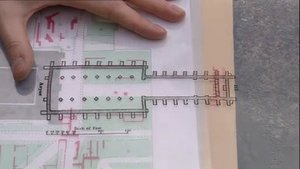
The team are on the trail of a medieval mystery. Founded by Henry V and built by his son Henry VI, Syon Abbey was a large, wealthy monastery for nuns of an obscure Swedish order. During the reign of Henry VIII it vanished. Its remains lie beneath the lawns of modern Syon House, designed by Capability Brown. What they find is on a huge scale. But there is disagreement as to what kind of building it was. After investigating the foundations of the House, Stewart and Jonathan reach an agreement on the extent of the church. They are joined by buildings historian Jonathan Foyle and monastic expert Barney Sloane.
Episode 3
The Crannog in the Loch - Loch Migdale, Scottish Highlands
There's an island-ish round area of stones in Loch Migdale - could it be a crannog? 200 meters away on the banks is a small (12 m diameter) circular feature - is it a henge? Time Team rounds up some experts on the prehistoric and finds out. They set up a suction dredge to investigate two areas of the loch feature, and find wonderfully preserved timber, proving that it's a built structure and thus a crannog. GPS surveying and a tip from a local farmer finds the causeway, now underwater, leading to it Trenches within the henge show that the entrance and wooden posts within it pointed towards notable features in the landscape. Stewart looks for the find site of the Migdale Hoard.
Episode 4
Saxon Burials on the Ridge - South Carlton, Lincolnshire
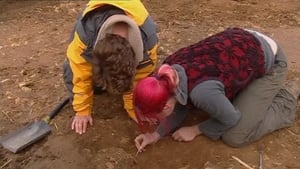
The team investigate a possible fifth century cemetery in a ploughed field, where they find a metal shield boss. One male skeleton is holding a drinking vessel. There are hints of much earlier activity as well, including a Bronze Age barrow. Using authentic tools, they fashion a Saxon shield. Conservator Dana Goodburn-Brown examines the details in the x-rays of the shield boss; while Phil and members of Regia Anglorum demonstrate how the shields are used in battle. They are joined by bone specialists Alice Roberts and Margaret Cox, who unearth some coloured beads among the remains.
Episode 5
The Roman Fort That Wasn't There - Syndale, Kent
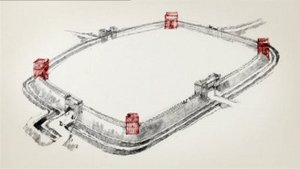
Nobody knows what happened immediately after the Romans arrived in 43 AD, because no Roman fort has been discovered in this part of South East England. Time Team are on a mission to find the missing link. Local archaeologist Paul Wilkinson believes he has already found a military ditch, which would surround such a fort. It's a prime site, right next to Watling Street. However geophysics cannot find any evidence for a ditch. So begins one of their most frustrating digs, directed by Neil Holbrook. Phil enlists in the Ermine Street Guard for a day. They are joined by Roman expert Tony Wilmott and pottery specialist Malcolm Lyne.

Episode 6
An Iron-Age Trading Centre - Green Island, Dorset
Green Island in Poole Harbour has already shown that it was a significant centre of Iron Age activity, with evidence of industrial activity and trading to and from the continental mainland. But it has never been properly excavated. Two huge jetties - now buried - indicate either a port or a defensive structure. The island is a SSSI (Site of Special Scientific Interest), which means hand-digging only, and replacing the topsoil. Very soon the finds start to multiply. Of particular interest is evidence of shale working for jewelry, and iron smithing. They are joined by Project Director Eileen Wilkes, archaeologist Miles Russell, Iron Age specialist John Collis, and metallurgist Roger Doonan. Experimental archaeologist Jake Keenan demonstrates shale working with primitive tools. Geomorphologist Vincent May explains that in prehistoric times the water level was two metres lower, and Green Island was much bigger.

Episode 7
A Medieval Blast Furnace - The Old Furnace, Oakamoor, Staffordshire
The team are revisiting the garden of Furnace Cottage in Churnet Valley, where the previous excavation of an Elizabethan blast furnace produced evidence of much earlier iron-making. Stewart surveys the landscape, to piece together a picture of water flow and other features essential to iron smelting. But John is convinced that there is strong geophysical evidence for a furnace a mile away at Eastwall Farm. It could even be water-powered - a major discovery. They build a medieval style bloomery. They are joined by historian Pete Brown, and archaeologists David Cranstone, Bill Klemperer, Deb Ford, Gerry McDonnell, Tim Young.