The Roman's Panic - Ancaster, Lincolnshire
Ancaster has yielded numerous Roman finds as well as a large cemetery with several sarcophagi from the period. In addition, the church is known in British archaeology for a Roman inscription dedicated to the deity Viridius. Phil finds the cemetery level, while Carenza discovers a layer filled with jumbled up human remains mixed with other bones. In the cemetery, Phil eventually uncovers the lid of a possible sarcophagus, and its excavation could thus require certain precautions due to the potential for lead poisoning and presence of biological hazards. However, the object proves to be a cist burial, as well as hazard-free. Incredibly, one of the cist slabs also turns out to contain yet another inscription to the god Viridius. In the end, the archaeologists suggest that the massive defences were ordered to be put up by the Roman central administration in Britain, and completely disrupted the original town layout.
More from Season 9
Episode 1
London's First Bridge - Vauxhall, London
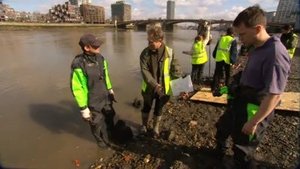
At low tide on the foreshore of the Thames near Vauxhall Bridge in central London, a series of timber stumps is visible. How old are they, and what was their purpose? Time Team have the task of finding out, before the stumps are destroyed forever. They want to create a picture of the Bronze Age landscape here, 3,500 years ago. Post holes would indicate dry land building, while piles (pointed stakes driven into the ground) would indicate a structure above the river. To find out, they have to dig up one of the massive stumps. It's a race against time and tide to get it done in three days. Phil helps Damian Goodburn to make a simple piledriving rig with authentic tools. Stewart and Mick take a trip on the London Eye, to help them map the course of the ancient river. They are joined by Gustav Milne from University College London, and Jon Cotton from the Museum of London.
Episode 3
Diving for the Armada - Kinlochbervie, Sutherland
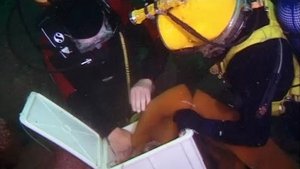
The team travel to West Scotland to investigate the wreck of a ship that may have been part of the Spanish armada. As this is a classic case of rescue archaeology, they are joined by the government's Archaeological Diving Unit, whose director Martin Dean explains why this exercise is so important. An ROV is operated from the surface. Historian Felipe Fernández-Armesto talks about the role played by the weather in the Spanish armada. Pottery specialist Duncan Brown looks at several remarkable finds, including some Maiolica ware. Both Phil and Tony do some diving. With the help of marine archaeologist Mark Lawrence, John uses a magnetometer to survey the seabed.
Episode 4
The Naughty Monastery - Chicksands, Bedfordshire
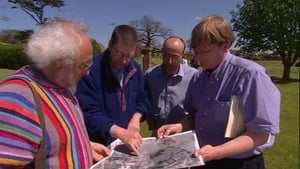
The team are invited to investigate the officers' mess of a military base in Bedfordshire, once home to monks and nuns of a 14th century Gilbertine Order. It was an experiment in unisex living. Jenni of Time Team volunteers to live like a nun during the dig, and is initiated by nunnery expert Roberta Gilchrist. John Ette from English Heritage monitors proceedings, and they are also joined by historian Richard K. Morris and osteoarchaeologist Margaret Cox. Robin Bush tells the miraculous tale of the Nun of Watton.
Episode 5
The Furnace in the Cellar - Ironbridge Gorge, Shropshire
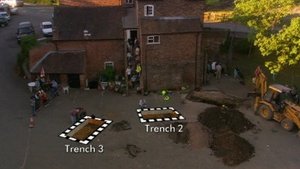
The team head for a pub in Leighton, whose cellar contains the remains of a blast furnace once used for smelting iron. When Tony arrives, test pits are already being dug, and Geophysics are busy surveying the car park. They are joined by Paul Belford from Ironbrige Gorge Museum; and Jonathan Roberts shows Phil how to make a triangular charcoal clamp similar to those used in the 17th century. Mick visits the nearby Blists Hill Victorian Town, where Roger Fewtrell demonstrates making a 24 pound cannonball. They are also joined by researcher Colin Thom, industrial archaeologist Rob Kinchin-Smith, archaeometallurgist Gerry McDonnell, and finds expert Ceinwen Paynton.
Episode 6
An Ermine Street Pub - Cheshunt, Hertfordshire
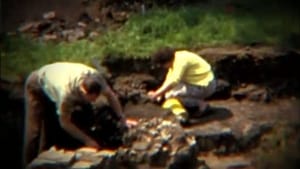
It is 40 years since amateur archaeologists dug up Roman remains near Ermine Street, now hidden beneath Cheshunt Park. Time Team tell the story of the original excavation, using the detailed plan to conduct their own investigation. They believe the site's proximity to the road is the key to this dig. With some brilliant work by Stewart and John, they soon locate part of the road. Though frustratingly they cannot find any trace of it beneath the surface, they do find a brewery and possibly a pub. The brewing process is described by ancient technology expert Peter J. Reynolds. They conduct a mini-experiment comparing Roman surveying techniques with Henry's modern equipment. They are also joined by Roman experts Rosalind Niblett and Harvey Sheldon.
Episode 7
Iron-Age Market - Helford, Cornwall
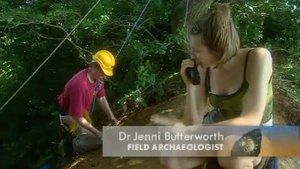
Two massive hill forts on the Lizard Peninsula in Cornwall, at Gear and Caer Vallack, have never been excavated. In fact, no major Cornish Iron Age site has ever been investigated. Time Team have been given the tall order of making some sense of these two sites in three days. For many years, a local farmer has been collecting Stone Age and Iron Age artefacts. Already the geophysics results are showing a potential wealth of ancient human activity. But the sites are so huge that the team will have to be very selective. They are joined by Ian Morrison from English Heritage, ancient technology expert Peter J. Reynolds, pottery experts Carl Thorpe and Henrietta Quinnell. Re-enactor David Freeman demonstrates a sling-shot, a simple but effective weapon. Phil and Peter visit a reconstructed round house nearby.